Qwen4-Max is here, and it’s not quite the Claude killer Alibaba hoped for

Qwen4-Max is here with 2.4 trillion parameters and a claimed 62% reduction in task costs. Alibaba’s benchmarks look impressive, but early independent tests and developer feedback are far less consistent. Is cheaper actually better?
Alibaba has released Qwen4-Max, its new flagship model and the successor to Qwen3.8-Max. It has 2.4 trillion parameters and a one-million-token context window, and Alibaba says it can go toe to toe with the best from OpenAI and Anthropic at a fraction of the running cost.
The details: Qwen4-Max is a Mixture-of-Experts (MoE) model, so it never fires up all those parameters at once. Only a slice does the work on any given response.
- Active parameters: 71 billion out of 2.4 trillion, about 25% fewer than Qwen3.8-Max.
- Context window: One million tokens, enough to hold whole documents and codebases.
- Architecture: Alibaba has reworked parts of the attention system and other components to squeeze out more efficiency.
The biggest change may be the bill. Alibaba has cut API prices, but that’s only half of it. Qwen4-Max also needs fewer tokens to finish the same tasks as its predecessor, which matters if you’re running complex AI agents.
According to Alibaba’s evaluations:
- Work360: Token consumption dropped by 24% at Xhigh reasoning effort and 35% at High.
- Terminal-Bench 4.0: Token usage fell by 48% to 49%, depending on reasoning effort.
- Cost per task: The average cost on Work360 fell from $4.43 to $1.67, a 62% reduction.
That’s a big gap, and it compounds fast when you remember how many model calls an autonomous agent can burn through on a single task. But these are Alibaba’s own numbers, so your savings will depend on your workload.
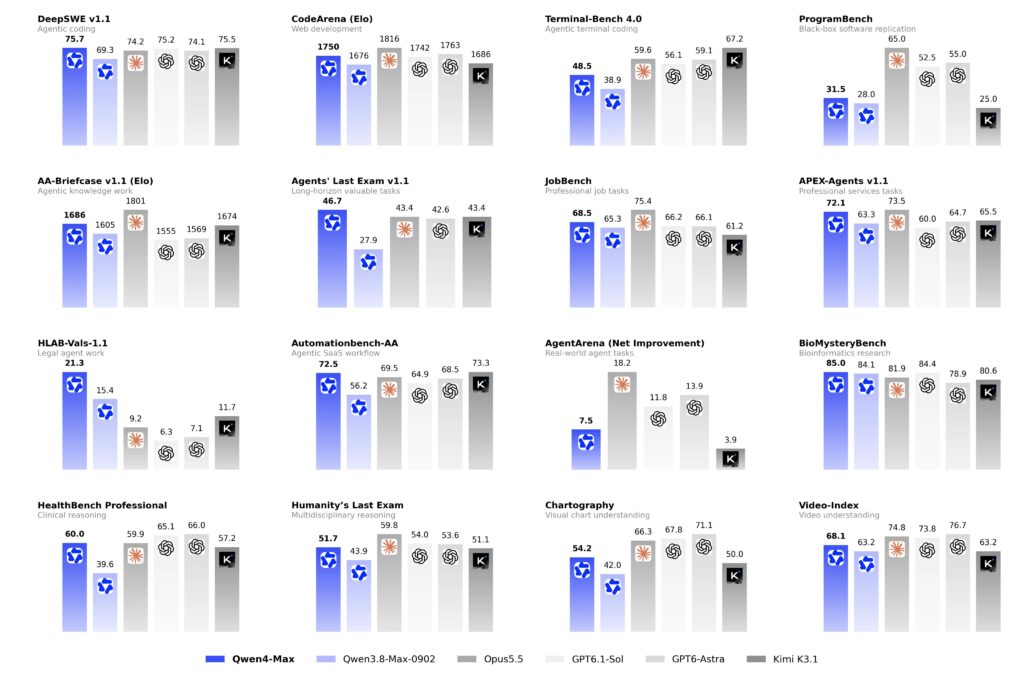
The benchmarks: Alibaba’s results place Qwen4-Max among the leading proprietary models, though it doesn’t win everywhere. Some of the losses are steep.
- DeepSWE v1.1: 75.7, against Claude Opus 5.5’s 74.2.
- Agents’ Last Exam: 46.7, ahead of Opus 5.5 and Kimi K3.1 at 43.4.
- BioMysteryBench: 85.0, narrowly ahead of GPT-6.1 Sol at 84.4.
- Terminal-Bench 4.0: 48.5, well behind Kimi K3.1 at 67.2.
- ProgramBench: 31.5, against Opus 5.5’s 65.0.
It also scored an Elo of 1750 on CodeArena, good for sixth place. So it keeps company with the best in some areas, and in others it’s left far behind.
Yes, but: Early reception among developers has been mixed. Some who tried Qwen4-Max Preview were impressed, especially by the games and interactive apps they built with it. Others ran into slow execution and unreliable tool calling, which is a worrying flaw in a model meant for complex agentic workloads.
Independent testing from Spring Prompt was just as uneven:
- Presentations: First among 32 models.
- Survey analysis: Fifth among 23 models.
- Factual product listings: 19th, with only 39.3% of outputs consistently meeting the test’s publishing requirements.
Keep these separate from Alibaba’s official benchmarks. Most of the community feedback comes from the preview version, and Spring Prompt’s evaluations cover a limited number of runs. There isn’t enough independent testing yet to say how the production model holds up across different tasks.
Pricing and availability: Qwen4-Max is available through QwenCloud’s API and Token Plan, as well as QwenStudio and QwenWork.
- Input: $1.50 per million tokens.
- Output: $4.50 per million tokens.
- Cached input: $0.075 per million tokens.
One catch: Qwen4-Max isn’t open-weight. Alibaba plans to release smaller Qwen4 models with downloadable weights, but it hasn’t said which ones or when.
Get the core business tech news delivered straight to your inbox. We track AI, automation, SaaS, and cybersecurity so you don't have to.
Just read what you want, and be done with it.