Federal Jury Dismisses Musk’s $150B OpenAI Claim in Under Two Hours

A federal jury dismissed Musk’s $150B OpenAI lawsuit in under two hours. Also: Cursor’s new model rivals Claude Opus, FLUX goes MCP-native, and Google I/O is live today.

A federal jury in Oakland unanimously dismissed Elon Musk’s lawsuit against OpenAI in under two hours, clearing the company’s IPO runway at an $800B+ valuation.
Cursor shipped Composer 2.5 on a Moonshot base model with near-Opus coding benchmark scores. Odyssey ML published Starchild-1, a real-time world model that generates synchronized video and audio in one pass. Black Forest Labs made FLUX a native MCP server. And Google I/O is live today.
★ Lead Story · Legal · OpenAI
Federal jury dismissed Musk’s OpenAI lawsuit in under two hours. The verdict clears OpenAI’s path to an IPO at an $800B+ valuation.

A federal jury in Oakland delivered a unanimous verdict against Elon Musk, dismissing all claims in his lawsuit against OpenAI. Deliberations lasted less than two hours.
The court ruled Musk’s claims were barred by the statute of limitations. Musk had sought $150 billion in damages, alleging that OpenAI abandoned its founding nonprofit mission by pursuing commercial partnerships and a for-profit structure.
The verdict removes a significant legal overhang on OpenAI’s IPO process. The company’s last reported valuation stood above $800 billion, and several institutional investors had been monitoring the case before committing.
TL;DR
Unanimous dismissal, under two hours. Musk’s $150B claim is dead and OpenAI’s IPO runway is clear.
Research · Multimodal AI
Odyssey ML released Starchild-1, a real-time world model that generates synchronized video and audio in a single pass

Odyssey ML published Starchild-1, a real-time multimodal world model that outputs video and audio together as a synchronized stream. The model runs at approximately 24 frames per second in causal mode, generating each frame based only on the sequence so far.
The architecture uses causal distillation and an asynchronous KV-cache that handles video and audio at different rates, allowing long-horizon generation to stay stable. Most comparable models produce audio separately and sync it in post-processing. Starchild-1 does not.
Odyssey was founded by Oliver Cameron (previously Cruise and Voyage) and Jeff Hawke (previously Wayve). Backers include GV, EQT, NVentures, Samsung Next, Elad Gil, and Jeff Dean. Starchild-1 follows the company’s earlier Odyssey-2 and Agora-1 models. No public demo is available at launch — this is a research preview only.
TL;DR
Starchild-1 generates video and audio together in real time without a separate sync step. Research preview only, no public demo.
Dev Tools · Coding Agents
Cursor’s Composer 2.5 scores near Claude Opus 4.7 on SWE-Bench and costs roughly 10x less per task than GPT-5.5
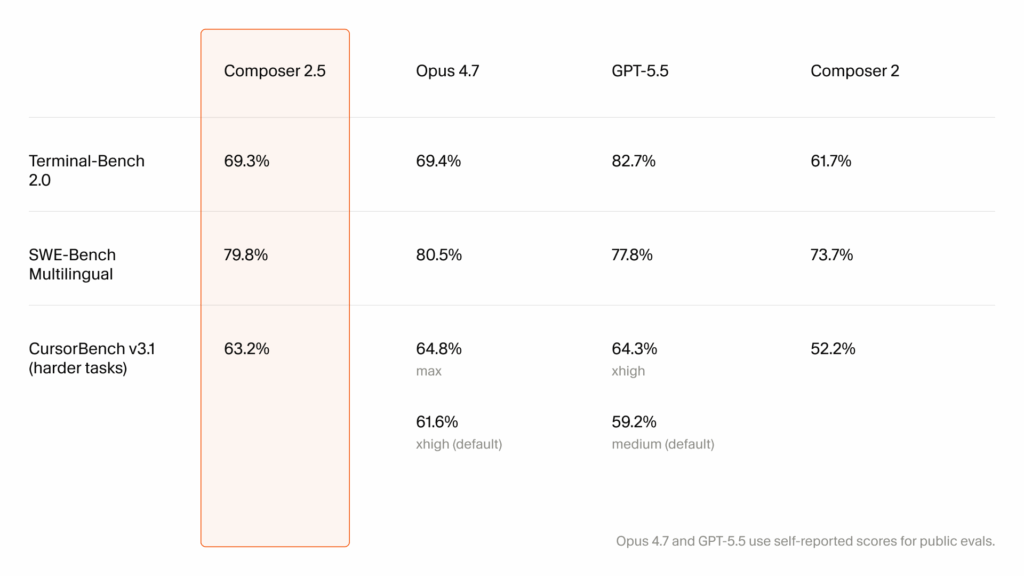
Cursor released Composer 2.5, built on Moonshot AI’s Kimi K2.5 base model with additional reinforcement learning training. On SWE-Bench it scores 79.8%, placing it near Claude Opus 4.7’s result. On Terminal-Bench 2.0 it scores 69.3%.
Cursor reports the model costs roughly 10x less per completed task compared to GPT-5.5. Free-tier usage limits are doubled for one week from launch.
The release notes reference a compute partnership with an entity Cursor calls “SpaceXAI” for scaling a larger future model. The name does not correspond to a known company and likely refers to xAI and its Colossus 2 cluster, but Cursor has not confirmed this.
TL;DR
Near-Opus coding performance, 10x lower cost per task, on a base model most people haven’t heard of.
Sponsored
 RunPod
If you need on-demand GPUs for training, fine-tuning, inference, or running open-source models, give RunPod a try.
- Available hardware: H100, H200, A100, L40S, RTX 4090, RTX 5090, and 30+ more
- Cost: significantly cheaper than AWS or GCP, billed per second, no contracts
- Setup: spins up in under a minute, 30+ regions worldwide
Affiliate disclosure: We may earn a commission if you sign up via our link, at no extra cost to you.
Dev Tools · Image Generation
Black Forest Labs launched an official MCP server for FLUX that routes requests automatically across models by complexity
Black Forest Labs released a native MCP server for FLUX at mcp.bfl.ai. The server connects FLUX to any MCP-compatible client, including Claude, Cursor, Codex, and Hermes, without requiring a separate API key. Authentication runs through OAuth using BFL credits.
Model selection is handled automatically: Klein for fast concept drafts, Pro for refinement, and Max for final renders. Developers can run up to 8 generations in parallel and request variations, inpainting, outpainting, and style transfers from within the client.
Generation history is tracked server-side, allowing clients to reference or iterate on previous outputs without re-uploading context.
TL;DR
FLUX is now a native MCP tool with OAuth auth, automatic model routing, and parallel generation — no separate API key needed.
Research · LLMs
Sapient Intelligence trained a 1-billion-parameter reasoning model in one day for about $1,000

Sapient Intelligence released HRM-Text, a 1-billion-parameter model trained on 40 billion structured tokens in approximately one day at a cost of around $1,000. Instead of generating explicit chain-of-thought reasoning, it uses a hierarchical approach that operates in latent space, producing both high-level and low-level reasoning signals internally.
On standard benchmarks, HRM-Text is competitive on math tasks, DROP, ARC-Challenge, and MMLU while using roughly 1/900th the training data of Qwen3.5-2B. The comparison is not a direct equivalence, but the data efficiency gap is the point.
TL;DR
1B parameters, no chain-of-thought, trained in a day for $1,000, competitive on math and reasoning benchmarks against models trained on orders of magnitude more data.
~$1,000
The reported training cost for HRM-Text, a 1-billion-parameter reasoning model trained on 40 billion structured tokens in approximately one day. For comparison, Qwen3.5-2B used roughly 900 times more training data. Source: Sapient Intelligence.
AI Strategy · Meta
Meta is reassigning 7,000 employees to AI roles while cutting 8,000 jobs and 6,000 open positions

Meta is moving 7,000 employees into four new AI-focused organizations built around fewer management layers. Alongside those reassignments, the company is laying off 8,000 workers and closing 6,000 open positions — a total that represents nearly 10% of Meta’s headcount of approximately 78,000 at the end of 2025.
CEO Mark Zuckerberg has committed $115 billion to $135 billion in AI spending this year, covering data center construction and a new superintelligence team. The restructuring follows the company’s prior shift away from metaverse investment.
The layoffs follow a pattern Meta established in 2023, when it cut more than 21,000 jobs. The scale of this round is smaller, but the retained headcount has a more specific destination.
TL;DR
Meta cuts nearly 10% of its workforce while funneling thousands of roles into AI orgs, backed by up to $135B in planned AI spending this year.
Infrastructure · Meta
Meta is getting $3.3 billion in Louisiana tax breaks for a data center that will add 5,200 megawatts of natural gas generation to the region

Meta’s Hyperion data center campus in Richland Parish, Louisiana spans 2,250 acres and costs around $10 billion to build. Louisiana is providing $3.3 billion in tax relief, including zero sales tax on GPUs purchased for the site. That sum is enough to cover the state’s police budget for seven years.
Powering the campus requires adding 5,200 megawatts of natural gas generation on top of 2,262 megawatts already under construction in the region. Energy providers and environmental groups have filed petitions over noise and air quality impacts on local residents.
Housing prices in the surrounding area rose more than 170% by September 2025. The project is expected to create about 500 permanent operational jobs in a region where average wages are well below the national average.
TL;DR
$3.3B in tax breaks, 5,200 new megawatts of natural gas generation, housing up 170%, and 500 permanent jobs.
Google · AI Assistants
A leaked Gemini desktop build reveals local file access, a video model component, and a screen-reading feature not yet announced

A leaked build of Google’s Gemini desktop app reveals several capabilities ahead of today’s I/O announcements. A component called Gemini Spark reads local files from attached folders, giving the AI direct access to content on the user’s machine. A feature called Stream to Cursor controls the screen pointer, similar to the Magic Pointer shown at a previous Android developer event.
The build includes a component labeled internally as Gemini Omni, described in the code as “Veo4 Omni,” suggesting integration of Google’s video generation model into the desktop assistant. Gemini Live is present in the build but listed as a work-in-progress and nonfunctional in this version.
The app also supports Skills. These details come from a leaked build and have not been confirmed by Google.
TL;DR
Google’s Gemini desktop app has local file access, video model integration, and screen control built in — none of it confirmed by Google yet.


⚡ Quick Hits
- Google I/O is live today with the keynote beginning at 10am PT. It’s the first I/O since Google announced Gemini 2.0, and expectations include the desktop Gemini app, Veo 4, and deeper Android integration.
- TinyFish raised a $47M Series A led by ICONIQ for its free web search API integrated with Raycast. Founded by Sudheesh Nair (ex-Nutanix CEO), Shuhao Zhang (ex-Meta), and Keith Zhai (ex-WSJ). Four tools: Search and Fetch are free, Browser runs a stealth Chromium instance, Agent handles multi-step tasks. Enterprise customers include ClassPass, DoorDash, and Grubhub.
- ByteDance released Lance, a 3-billion active parameter multimodal model handling text, image, and video in a single architecture. Scores 84.67 on DPG-Bench (above FLUX.1-dev) and 85.11 on VBench. Apache 2.0 on HuggingFace, minimum 40GB VRAM.
- xAI’s creative models are now on OpenRouter. Grok Imagine generates photorealistic images at up to 2K resolution with multilingual text rendering. Grok Imagine Video produces clips up to 15 seconds using up to 7 reference images. Grok Voice TTS 1.0 offers 5 voices across 20+ languages with inline speech tags.
- Lovable launched Skills, reusable AI workflows stored as markdown files that apply custom styles, rules, or processes to projects. Can be invoked manually or automatically, created by describing them in chat, and imported or exported including from Claude. Five built-in Skills at launch.
- Browserbase open-sourced browse.sh, a verified skill catalog for web browsing agents installable via npm. Partners at launch include Ramp and Lovable. All skills are free, and contributors can add their own via pull request.
- Krea released Krea 2, a new foundation image model with style sliders for fine-grained aesthetic control. Unlimited generations for one week from launch.

Get the core business tech news delivered straight to your inbox. We track AI, automation, SaaS, and cybersecurity so you don't have to.
Just read what you want, and be done with it.